
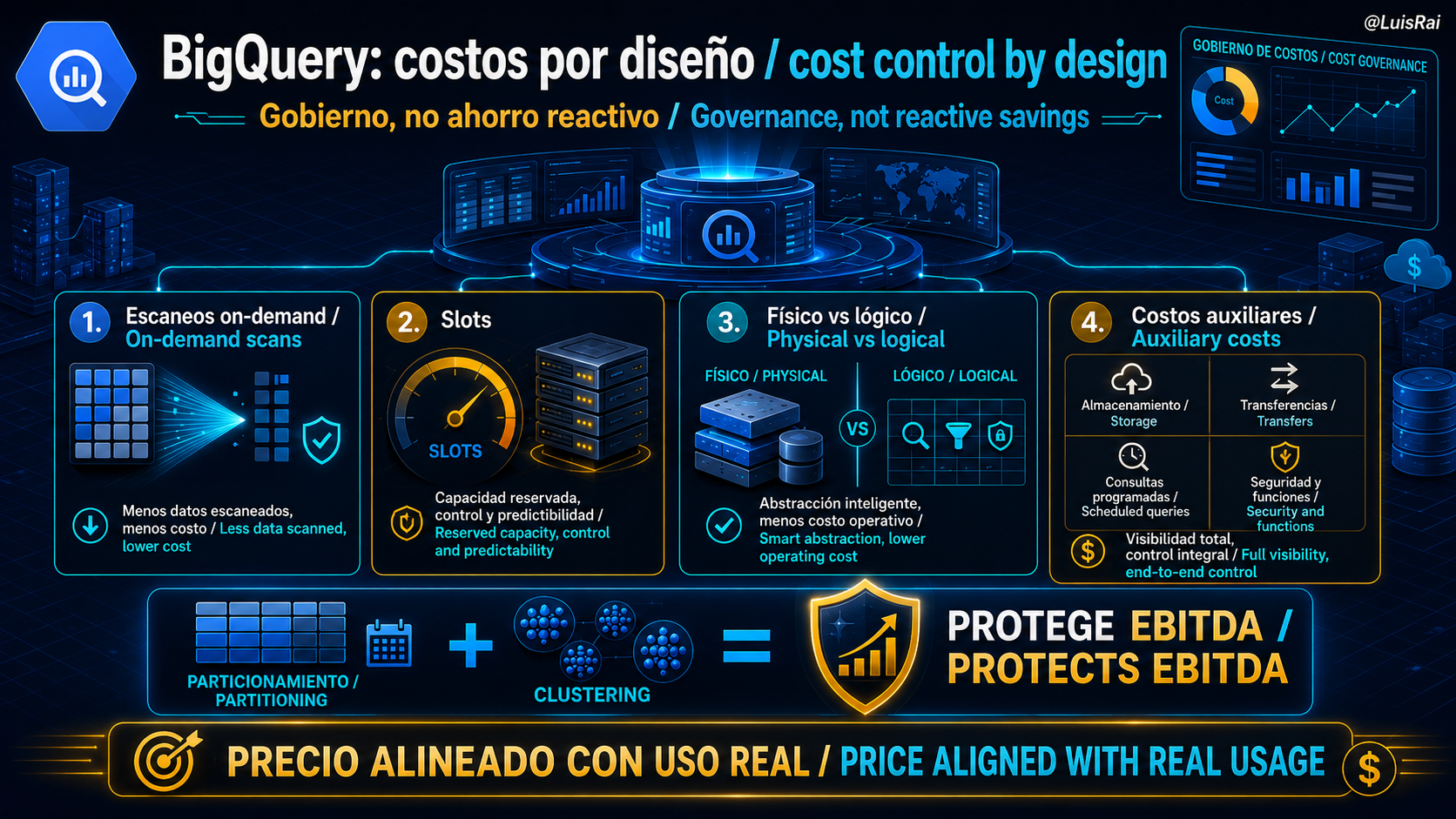
BigQuery cost control, from reactive savings to preventive governance
What is it?
On Monday morning, a technical lead at an insurance company in Bogotá opens the Google Cloud billing dashboard and finds a 40% jump in BigQuery costs. No system failures were reported, no security breaches occurred, and the analytics team operated as usual. The issue was not a technical bug but an "exploratory query" launched by an intern that performed a full scan on a ten-year historical table, without partitions or filters.
When cost control is limited to checking the bill at the end of the month, the organization is paying a tax for architectural disorder that BigQuery, by its elastic nature, scales silently.
In simple terms, BigQuery separates storage from processing and bills the latter by volume of data scanned or by reserved capacity. Real cost governance requires understanding that efficiency is not born from banning queries, but from modeling data so the engine reads the minimum necessary. This means moving from an "unlimited use" mindset to a "budget by design" one, where every table and every query is evaluated for its financial impact before touching production.
What does it add?
Jordan Tigani, founding engineer of BigQuery, explains in his analysis on the end of "Big Data" that most organizations do not actually operate at petabyte scale, but they pay the inefficiency of systems designed for it. Optimizing cost provides financial predictability, reduces technical debt accumulated in inefficient data models, and frees up budget for real experimentation. In practice, a dashboard that loads in three seconds and costs ten cents adds more value than one that takes a minute and consumes ten dollars per refresh.
Technical depth requires understanding that BigQuery is not a billing monolith. It is not enough to optimize on-demand scanning; serious governance contemplates three concurrent fronts. First, the choice between on-demand compute (pay-per-TB) and editions (Standard, Enterprise, Enterprise Plus) based on reserved or autoscaled capacity (slots). Second, the storage billing model: traditional logical (uncompressed data) versus physical (compressed data), where the latter charges for time travel and fail-safe windows, making it profitable only for massive and stable datasets. Third, auxiliary costs such as streaming ingestion or the use of AI functions, which can double the bill if not associated with a capacity commitment.
The difference between a technically grounded operation and one without it comes down to how storage and processing hierarchies are leveraged. An unoptimized table forces the engine to perform a full scan, while a governed table uses time partitioning and clustering by query dimensions to discard irrelevant data blocks, cutting execution costs by orders of magnitude.
How to implement?
An operational contrast helps fix the difference between a naive query and one optimized for cost and performance, also considering the capacity model.
-- Scenario A: Naive query in on-demand model (Expensive and inefficient)
-- Full scan of a 2TB table without partition filters.
SELECT *
FROM `project.dataset.historical_sales`
WHERE country = 'Colombia';

-- Scenario B: Technical criteria in capacity model (Slot optimization)
-- Using partition, projection, and pre-materials to reduce compute load.
SELECT date, product_id, net_value
FROM `project.dataset.governed_sales`
WHERE date >= '2026-06-01' -- Pruning: only scans blocks for this day
  AND country = 'Colombia'    -- Clustering: skips non-matching blocks
  AND branch = 'Bogotá';     -- IO reduction and slot savings
In Scenario A, you pay for every byte in the table or consume thousands of unnecessary slots. In Scenario B, partitioning and clustering reduce on-demand costs by up to 90% and allow a slot reservation to serve three times as many concurrent queries.
A practical routine for real teams must evolve according to volume. For flows under 100TB/month, prioritize the on-demand model with custom quotas (QueryUsagePerUserPerDay) and per-project billing alerts. For massive flows or high concurrency, migrate to an Enterprise Edition with autoscaling reservations, setting a maximum slot limit to contain spending. In storage, switch to physical billing only if your compression ratio exceeds 50% and your data remains unchanged for more than 90 days (long-term storage); otherwise, time travel costs will cancel out the savings. Finally, integrate the query validator (dry run) into CI/CD processes to reject any deployment that projects disproportionate consumption.
How does it impact ROI and EBITDA?
When BigQuery governance reduces operational waste, the impact moves directly to EBITDA by converting unpredictable variable spending into a controlled and efficient cost. In terms of ROI, every peso saved on unnecessary scans is capital that can be reinvested in improving data quality or in generative AI models that generate revenue.
The decisive human value in this framework is not just knowing how to write SQL, but deciding responsibility boundaries over spending. That blend of architecture judgment, billing analysis, and operational discipline separates companies that see the cloud as an uncontrollable cost from those that use it as a platform for profitable growth.