
🗺️ The Agenda Is Not the Road
A Roadmap Is Not Production Quantum Capability
Quantum computing has spent months positioned in Colombian public discourse as if it were already an operational technology, with functioning hardware ready to integrate into actual productive processes. Communications talk about leadership and championing with the same naturalness one would speak of infrastructure available today. That jump between the announcement and technical reality lacks foundation.
Putting quantum computing on the national agenda is a legitimate decision; confusing it with having it as deployed infrastructure generates expectations that the field still can't satisfy.
To understand where this field really is you need to review the hardware. A qubit is the basic processing unit in a quantum computer, analogous to the classical bit but capable of simultaneously representing multiple states through superposition, a property that allows solving certain computationally intensive problems in ways that classical computing can't emulate with equal efficiency. Qubits are, however, extremely sensitive to any environmental perturbation; heat, vibration, and electromagnetic interference destabilize them in microseconds, which turns cryogenic isolation and noise control into engineering requirements that still limit the scale of these systems.
IBM, the manufacturer operating today the largest fleet of quantum computers accessible over the internet, had available in 2025 Eagle processors at 127 qubits, Heron r1 at 133 qubits, and Heron r2 and r3 at 156 qubits each, with 28 systems of more than 100 qubits active since 2022 and more than 3.6 trillion circuits executed in total. That advance is extraordinary for a technology that in 2016 was just a five-qubit processor available in the cloud.
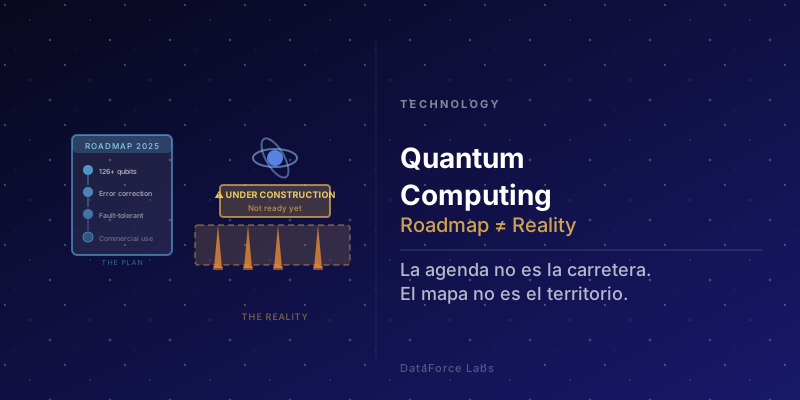
IBM's roadmap sets quantum advantage, which is the point where a quantum processor consistently surpasses the best classical algorithms in a real practical value problem, as a goal before end of 2026. The first fault-tolerant quantum computer at large scale has a projected date in 2029. Fault-tolerant means capable of automatically detecting and correcting inevitable errors in real qubits without stopping execution, and that capability is the technical requirement separating a prototype useful in niches from infrastructure for general purpose. The agenda is clearly traced; the road has sections under construction.
In June 2024, the UN General Assembly proclaimed 2025 as the International Year of Quantum Science and Technology, recognizing the centennial of initial development of quantum mechanics. The stated purpose of that initiative was to increase public awareness of the field's importance and applications, not certify massive adoption. During that year countries shifted from asking whether to join the quantum agenda to asking how to build coordinated, credible programs with real impact; IBM contributed to that effort at the UN Science, Technology, and Innovation Forum for the Sustainable Development Goals, sharing practical routes for talent development and ecosystem building.
Think of two CIOs advising their boards at mid-sized companies in Bogotá. The first heard the political discourse and included integrating quantum computing into the logistics optimization platform in next fiscal year. The board approved because it sounded strategic and aligned with the national agenda.
The second brought a different question before producing any proposal. What concrete problem in our operations would you expect a quantum algorithm to outperform the classical solver we already use? What level of quantum error correction would the system need to operate so the result is reliable? Quantum error correction is the technique detecting and compensating inevitable qubit failures, and it's exactly the requirement IBM identifies as the pending threshold before quantum computing is useful at general scale.
The first proposal lacks the hardware to support it today. The second builds the capacity to evaluate with precision when that hardware will be available and what the team needs to take advantage of it when it arrives. The agenda is not the road, and that difference determines whether money invested in quantum exploration produces strategic learning or a project that can't be executed.
Colombia has real signals of public policy in quantum technologies, with calls in metrology, sensors, energy, and exploratory lines in mine clearing. Building human knowledge infrastructure today is the correct strategic decision; that foundation will be ready to operate when hardware matures. IBM's 2025 Qiskit Global Summer School brought in more than eight thousand attendees from 115 countries, including Latin American participants with access to real quantum computers through the cloud, and the same year's Qiskit Fall Fest mobilized more than 32 thousand participants from 49 countries with triple growth versus the prior year.
What is not road is declaring that you've already arrived. When political discourse jumps from building capacities to implicitly stating that Colombia already leads a technology whose mature phase IBM projects for 2029, the problem isn't ambition but imprecision. Teams making budgetary decisions based on that imprecision end up with plans the market can't execute.
When e-commerce arrived in Colombia in the late nineties, several companies designed complete strategies for selling online when residential internet coverage was minimal and digital payment systems practically didn't exist. The GPS pointed to the destination of the digital economy; the highway connecting to it was unpaved. Companies that survived weren't the ones that believed the announcement as it arrived; they were the ones that understood exactly how much was left to travel and what needed building in the meantime.
Recommended Resources
- IBM Quantum. Current hardware and official roadmap (technical reference)
- International Year of Quantum Science and Technology 2025. Official IYQ website (reference portal)
- IBM Quantum Blog. A look back at the International Year of Quantum (community report)
First review IBM's public roadmap to know when fault-tolerant hardware will be available, then identify whether there's any problem in your organization whose complexity would make it a candidate for quantum advantage, then invest in formation in quantum algorithms because that capability can be built today with open resources, finally follow IBM's Quantum Advantage Tracker to distinguish verified advances from announcements without experimental backing.
In your company or sector is anyone already mapping what types of problems could benefit from quantum computing when hardware matures, or is the conversation still at the headline level? 🗺️