
🎓 When the classroom loses connection
Technical Education Needs Real Operational Context
At seven in the morning a data team got a billing pipeline alert and the new analyst opened the failed job in the orchestrator. The analyst still needed forty minutes to understand why a retry was duplicating rows in a critical table, a timeframe that proves very little because a serious senior engineer can take that long or longer when a failure crosses dependencies, closing data, and business rules. The real problem appeared later, when the analyst could not read the architecture, find the retry documentation, or separate symptom from cause before proposing changes.
When technical education ignores real operations, the problem is not initial delay but the inability to interpret evidence, understand the system, and size the change to the actual failure.
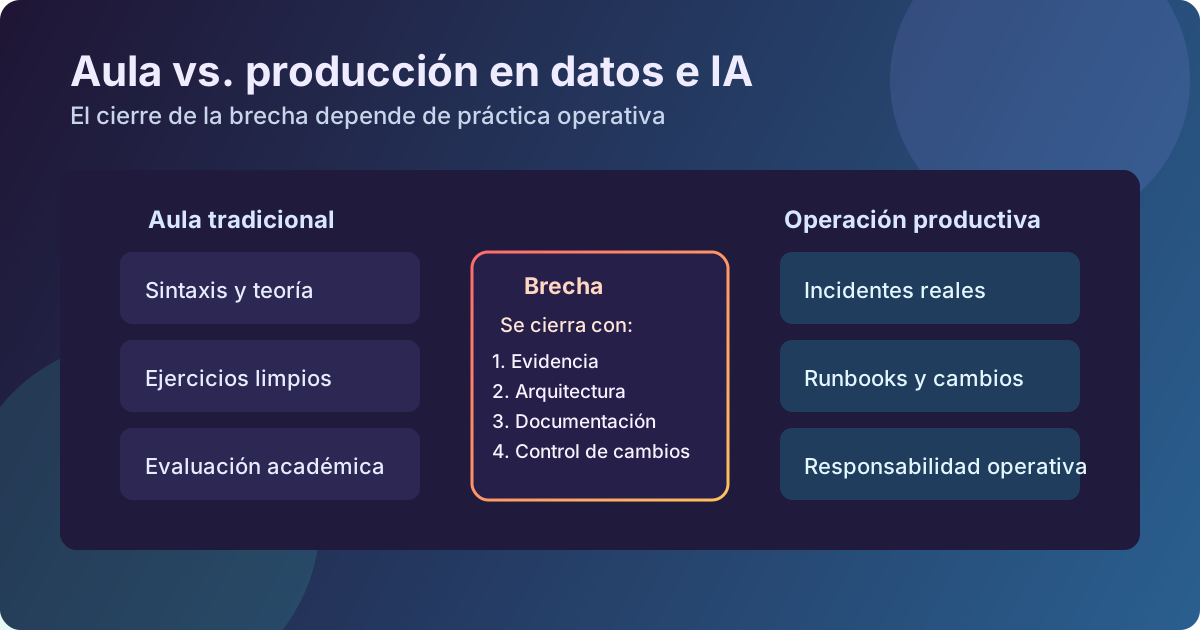
In practical terms the gap is not about theory itself, it is about distance between curriculum and production operations. In data and software, production operations means a service that does more than run code and actually meets uptime, traceability, security, and correctness commitments under real business schedules. Put plainly, a graduate may know how to solve exercises and still be unprepared to keep a service stable under pressure, and the real separator is not speed but the ability to read evidence, understand dependencies, use documentation, and keep the change proportional to the problem.
Recent evidence points in the same direction. The World Economic Forum reports that a large share of the workforce will require major reskilling by 2030, while Stack Overflow data in 2024 shows broad use of AI assistants but persistent concern about output quality and weak performance on complex tasks. Tool usage is growing and operational judgment still remains scarce.
Companies discover that gap on the day coursework is no longer available as an excuse. If programs are designed without real incident review, living architecture diagrams, runbooks, and postmortem practice, graduates get good at clean exercises while real teams work with incomplete data, strict permissions, and narrow maintenance windows. My interpretation is that first year friction at work often comes not from low potential but from training that skipped how to narrow a failure, read useful documentation, and avoid oversized changes before the problem is understood.
The historical parallel is instructive. Early twentieth century reforms around the Flexner report pushed medical education away from disconnected lectures and toward science based and supervised clinical practice. Different field and same lesson, quality improves when training is tied to real decisions with real consequences.
The same idea can be shown in a small data engineering contrast between touching a system blindly and fixing a failure with judgment.
def fix_without_judgment(job, conn):
    conn.execute("TRUNCATE TABLE sales")
    job.config["write_mode"] = "replace"
    job.run()

def fix_with_judgment(job, conn, runbook):
    cause = read_runbook(runbook, "duplicate_sales")
    if cause != "retry_without_idempotency":
        return "escalate_and_keep_investigating"
    enable_upsert(job)
    register_retry(conn, job.batch_id)
    test_in_staging(job)
    return "targeted_fix"
The first response is not wrong because it is slow, it is wrong because it is disproportionate. It deletes data, changes write mode, and reruns the process without proving that the cause, the affected architecture, or the incident history were understood. The second starts from the runbook, narrows the diagnosis, and limits the change to what the problem actually requires. That difference between touching and understanding is what teams expect from someone who arrives almost ready for production.
A full enterprise stack is not mandatory in every program. A short track may prioritize fundamentals and still be valid if it includes at least one full cycle with noisy data, architecture reading, technical documentation use, change control, and incident review. The key is not tool size, the key is operational evidence at the end of training.
Teacher profile also matters. A professor may accumulate courses, specializations, master's degrees, or doctorates and still have never owned a month end incident, a service degradation, or a delicate rollback. The problem is not the degree itself but using the degree as a substitute for senior production experience. In that system there are many perfect exercise repositories and far fewer people who can teach how to read living architecture, document decisions, and avoid oversized changes for a narrow failure.
The constructive response is not to dismiss academia but to stop pretending that prestige signals are enough. My reading is that in Colombia and much of Latin America we still reward curricular prestige more than verifiable production judgment. If an institution cannot find one person with both strong theory and real senior production experience, it should combine those profiles so that team leads do not inherit the full burden of teaching judgment after hiring.
Recommended resources
- World Economic Forum Future of Jobs Report 2025, report
- Stack Overflow Developer Survey 2024 AI, industry report
- European Commission Digital Education Action Plan 2021 2027, policy framework
- The Turing Way, open source practice repository
- Data Engineering Zoomcamp, applied technical course
The practical decision for companies and universities requires an auditable curriculum criterion. If a technical, technological, professional, or advanced program claims to prepare data and AI talent for production contexts, credentials and polished repositories are not enough. Real senior production experience, or co teaching with someone who has it, is what helps graduates arrive able to read documentation, understand architecture, document changes, and size the response before touching production. In teaching design terms, the strongest model combines highly trained theoretical profiles with senior applied engineering or technical leadership profiles, so conceptual depth and real operational judgment are developed together. If the program is explicitly foundational and does not claim production readiness, the bar can be lower, but it should still include at least one incident cycle with technical documentation and change control.
Resumen.
El artículo argumenta que la brecha entre aula y producción en datos e IA no se corrige con más teoría aislada ni con señales de prestigio curricular por sí solas. La evidencia combinada integra señales de mercado laboral, límites observados en herramientas de IA y una referencia histórica sobre formación supervisada en contextos de alta responsabilidad. El criterio operativo propuesto es concreto: antes de tocar producción, el egresado debe demostrar lectura de arquitectura, uso de documentación técnica y capacidad de acotar cambios según la causa real. La recomendación estructural es combinar perfiles de alta formación teórica con perfiles senior de ingeniería aplicada para cerrar la distancia entre concepto y operación.