
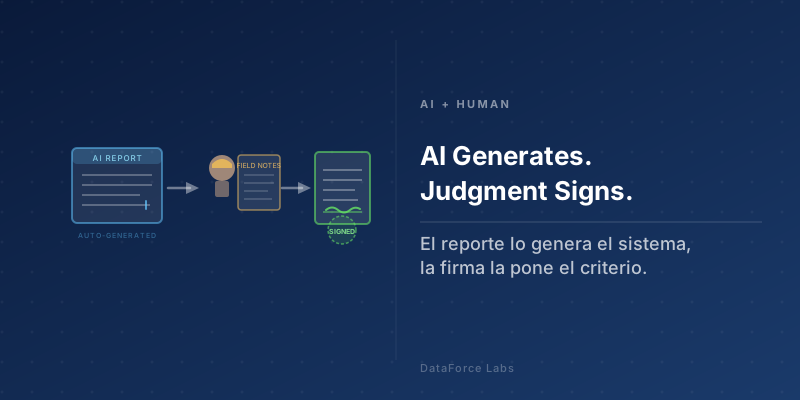
🏗️ The System Generates the Report; Judgment Provides the Signature
What GenAI Can Automate and What a Person Must Review
The conversation in Colombian industries has been going in the same direction for months: if a GenAI tool can produce monitoring reports, draft documented procedures, or consult the applicable regulatory framework in seconds, then the occupational health specialist, the human resources analyst, or the compliance professional are no longer needed. The conversation mixes two things that work differently.
Generative AI doesn't replace transversal administrative work; it replaces tasks within that work that don't require professional judgment.
In an industrial construction project, a BIM system (software that models the design and calculations of a building in three dimensions before work starts) generates plans, calculation reports, and schedules with formal speed. But it's the site resident engineer who walks the land and detects that the real soil profile doesn't match the geotechnical study. The system generates the plan. The decision to set foundations differently is made by someone who knows the terrain.
Generative AI tools (systems that produce text or documents from natural language instructions, available as services the provider operates over the internet) can execute compliance tasks with low decision risk: drafting a procedure from a template, reporting indicators from structured data, alerts for document expiration, tracking commitments in action plans, and quick consultation of applicable regulations. These activities consume real time in any transversal area of an industrial company and are real candidates for partial automation.
What that same system can't do falls in another category. It can't interpret why the accident rate indicator shows zero three months straight when operations changed without updating the report. It can't investigate the root cause of a non-conformity that on paper seems a labeling error but in the field stems from an unauthorized supplier change. It can't assume legal responsibility in a serious accident investigation or stop an activity when field evidence contradicts what the documented procedure says.
Think of two occupational health professionals in a manufacturing company in Valle del Cauca facing the same work accident investigation. The first uses the tool: the report comes out in twelve minutes with basic causes identified, action plan, and updated matrices. It formally meets Resolution 0312 of 2019, which is the regulation establishing minimum standards of the Occupational Health and Safety Management System in Colombia. Signs, sends, and moves to the next case.
The second uses that report as a starting point, goes to the area, and talks with the shift supervisor. They find that the task where the accident happened wasn't included in the Job Analysis for the affected position, which is the document where tasks, associated risks, and controls for each position are recorded. The root cause isn't PPE: it's a gap between the documented procedure and actual operations. The final report has different causes and a different action plan. Before a Ministry of Labor visit or a labor lawsuit, only one of those two documents protects the company and the worker. The system generates the report; judgment provides the signature.
This pattern has history. When ERP systems (platforms that integrate accounting, purchasing, payroll, and inventory in a single system) arrived in Colombian industry in the early 2000s, the prediction was that software would replace accounting assistants, purchasing analysts, and payroll coordinators. Companies that reduced their teams before anyone learned to audit what the system produced found months later their inventory was misaligned or payroll was calculated with parameterization errors. The tool processed transactions at speed; what it didn't detect was when the logic they'd entered was wrong.
The International Labour Organization published in August 2023 a global analysis on generative AI and employment concluding that the dominant effect of technology will be to enhance job capabilities, not automate them. The report notes that clerical roles, which include much of the recording, monitoring, and drafting within administrative tasks, have the highest exposure; but that the final outcome depends on whether whoever holds those roles can assume higher-demand functions within the same position.
The McKinsey Global Institute estimated in July 2023 that generative AI raises to 29.5% the proportion of labor activities automatable by 2030, versus the 21.5% projected without it. The study distinguishes office support roles, with greater contraction risk, from business and legal profiles, where the scenario isn't elimination but change in task composition toward greater weight in analysis, judgment, and decision with direct consequence. That distinction applies directly to transversal profiles in a Colombian industrial company.
In an industrial company, whoever only drafts routine reports and updates matrices without field context is in the segment with greatest automation exposure. Whoever investigates causes on site, interprets results with process knowledge, makes decisions with regulatory responsibility, and signs documents that have legal consequences occupies the segment no tool can replace because no system can assume the consequences of what it generates. The system generates the report; judgment provides the signature.
Recommended Resources
- International Labour Organization. Generative AI and Jobs - A global analysis of potential effects on job quantity and quality (report)
- McKinsey Global Institute. Generative AI and the future of work in America (report)
- MinTrabajo Colombia. Resolution 0312 of 2019 - Minimum standards of the Occupational Health and Safety Management System (regulatory reference)
[YouTube embed: Generative AI and the Nature of Work (AI & the Future of Work)]
First identify in your role what tasks are recording, drafting, or structured monitoring that a system could absorb, then experiment delegating those activities and measure the time you recover, then direct that time toward field work, causal investigation, and decisions with direct responsibility, finally review the ILO analysis on AI and employment to contrast the real exposure of your profile with the narrative circulating in your company meetings.
In your company, which transversal area has started using AI tools for its reports and how are they validating that the result is correct before signing it? 🏗️