
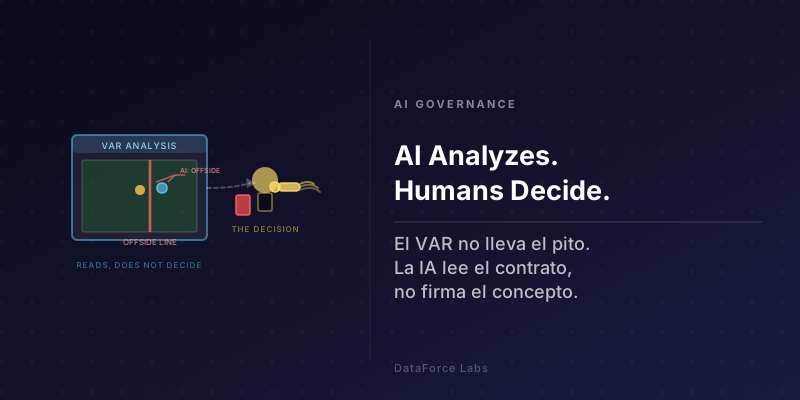
🏟️ In LegalTech, the AI That Reads the Contract Is Not the One That Signs the Opinion
Automating Analysis Does Not Delegate Legal Accountability
Many think AI adoption in legal services is slow because lawyers are conservative. The real friction is not cultural. Most organizations haven't yet defined where the analysis AI does well ends and where the professional responsibility that no system can assume begins.
In football, VAR can detect offsides with millimeter precision, replay the play, and measure angles. But the referee is the only one who can show the card. Not because the system is imprecise, but because the sanction is an act someone must sign. The VAR doesn't carry the whistle.
In document review or regulatory search the same thing happens. A system can read hundreds of contracts in minutes and flag outdated clauses or inconsistencies between parts.
A pattern like CQRS, where reading an file and modifying it are completely separate operations, allows AI to work on the document without touching the official record. The system analyzes and suggests. The lawyer reviews and signs.
Architecture defines that boundary. A BFF, which is a layer between the case management system and the professional's screen, can feed the intelligent assistant without giving it write access to the file. This way AI speeds up concept preparation. But the concept still belongs to someone.
Friction appears when the organization isn't clear on that line. The lawyer copying the assistant's response in the email to the client without reviewing it, or the analysis that remained attached to contract closure without anyone validating it, are symptoms of a flow that didn't distinguish between reading the play and making the binding decision. The VAR doesn't carry the whistle.
The 2024 Thomson Reuters report on GenAI in professional services gathered responses from 1,128 global professionals in legal, government, tax, accounting, risk, and fraud. Eighty-one percent believed GenAI could be applied to professional work, while the analysis also highlights concerns about reliability, accuracy, and the need to verify sources. This is not a technology gap but a question of who remains accountable. Researching and deciding are different activities.
In legaltech, the best architecture is not the one that automates more, but the one that accelerates judgment without weakening control. First you define where the line is between intelligent analysis and binding decision. Then you make sure flows respect that line. Then comes the human validation layer, visible and signed. Finally integrate the model.
When was the last time your team discussed who signs when AI suggests and no one reviews? 💬