
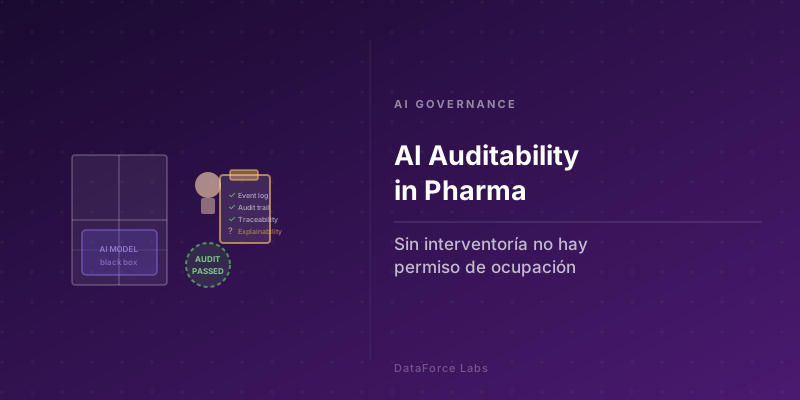
🏗️ In Pharma, AI That Delivers Results Without Proving How Doesn't Pass Regulatory Audit
A Regulated Prediction Needs Reproducible Evidence
Many leaders in life sciences believe AI adoption is slow because regulation is rigid or their organizations are conservative. The real obstacle is not cultural. It's architectural.
On a construction site, the inspector doesn't verify that the column can support the weight. They verify that the pour was done according to plans, with certified materials, and with the corresponding signed report. A structure that holds doesn't get occupancy permit if the construction log has gaps.
In pharma the same thing happens. The European Medicines Agency published in 2024 its guideline on AI in the medicine lifecycle, with process traceability as the central axis. The FDA followed in January 2025 with a guideline that made clear that a system working in production is insufficient if it can't reconstruct how it was trained and under what conditions it was validated.
A pattern like event sourcing, where each state change is recorded as an immutable event that can't be modified retroactively, allows answering regulatory questions without reconstructing the process from memory. Hexagonal architecture complements this by isolating the validation and compliance core from external systems, so no change in ERP or the lab alters the logic the auditor will review.
The real tension in this sector is between organizations that need to shorten the cycle in pharmacovigilance and supply chain, and systems that weren't designed to register their own behavior. In November 2025, the EMA and FDA jointly published the first common principles of AI in medicine development, with traceability and auditability as transversal axes of the product lifecycle.
A construction project without oversight can rise fast, but never gets occupancy permit.
In pharma, good architecture for AI doesn't pursue novelty, it pursues reproducible reliability. First you define what regulatory questions the system must be able to answer. Then you design the traceability layer that makes answering them possible. Then you choose the pattern that sustains them in production. Finally you integrate the model, not the other way around.