
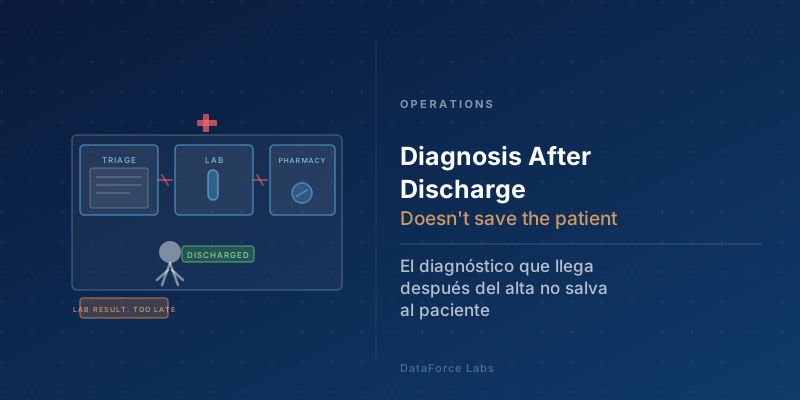
The Diagnosis That Arrives After Discharge Doesn't Save the Patient ✈️
Predictions Must Reach the Operational Workflow
Artificial intelligence in airlines is more than dynamic pricing engines and complaint chatbots. The true differentiator is whether prediction systems communicate in real-time with reaccomodation, maintenance, and passenger service systems. When that connection doesn't exist, AI predicts with accuracy but no part of the system acts on that prediction.
An emergency room where triage, lab, and pharmacy don't share data is an exact metaphor. The doctor diagnoses well, but the lab alert arrives two hours later. The prescription travels on paper. The result is correct, but the useful moment passed. In aviation that moment is when the plane still can be reassigned and the flight can still depart on time.
An airline operates on five dimensions in parallel: fleet, route network, personnel, pricing, and passenger channels. A climate or technical disruption hits all of them at the same time. If the systems managing them don't share state in real-time, the AI prediction arrives to an operation incapable of acting on it.
Two patterns connect those dimensions. The first is CQRS, separation between queries and commands: the model answering "is there availability?" operates separate from the one executing reaccomodation, avoiding blocks in critical operations. The second is event-driven architecture, where changes like a delayed flight or a plane out of service trigger events that interested systems process autonomously, without asking anyone what happened.
IBM's American Airlines case study documents that the dynamic rebooking application launched in less than half the expected time and, after Hurricane Irma, was ultimately deployed to more than 300 airports. In another IBM case study on Etihad Airways, a web check-in solution moved from a nine-month estimate to fifteen weeks and used preintegrated APIs to connect with 12 core systems. In both cases, value came not only from the algorithm but from integrating it with passenger channels and operations.
A correct diagnosis that arrives after discharge doesn't save the patient. In airlines, AI that detects the failure but doesn't reach the fleet system or passenger channel in real-time avoids no cost. It just describes the crisis with more precise data.
First the architecture connects operation and network in real-time. Then AI consumes that connectivity to anticipate the problem. Then reaccomodation and maintenance execute without manual intervention. Finally the passenger receives the information before arriving at the airport.