
A Map That Arrives After You've Crossed the River Doesn't Help You Navigate 🗺️
In the Field, a Late Signal Loses Its Value
AI in agribusiness is associated with reports describing how much was harvested, what quality the batch had, or how much was lost in the last quarter. The problem is not that those reports are inaccurate, it's that they arrive late. In the field, value doesn't lie in the historical summary but in the signal that arrives before damage becomes irreversible.
Imagine an exploration team in dispersed terrain with five separate instruments: temperature, soil moisture, equipment state, vehicle position, and lot quality in transit. Each operates on its own. Someone must read them one by one each morning to build the day's picture. When the decision arrives, the frost has already passed, the motor already overheated, or the fruit already started losing its point in the cold chain.
That's the tension of modern agribusiness. Operations are dispersed by nature—farms, trucks, refrigerated facilities, and warehouses at different points—but decisions must be made centrally and with updated information. When the systems measuring climate, production, logistics, and quality don't communicate, leadership operates with old maps and acts when the margin to recover the lot has already closed.
Event-driven architecture, where each sensor publishes a change and those needing to react receive it without asking, reduces the time between signal and action. If the temperature sensor in the refrigerated truck detects a deviation, the traceability system updates the lot state before it reaches the packing center. An IBM and Georgia Tech case study documents one concrete agricultural automation outcome: a 30% reduction in water waste. The figure cannot be generalized to every crop, but it illustrates why a useful signal must arrive on time and trigger an operational workflow.
Data pipeline, the route that signal travels from the field sensor to the model that decides, is the equivalent of connecting all the exploration team's instruments to each other. When crop prediction, equipment maintenance, and lot traceability share that pipeline, the central team stops waiting for the next day's consolidated report to act.
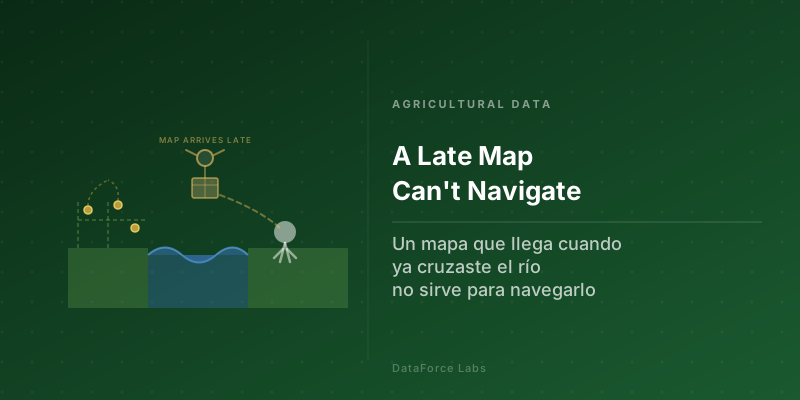
A map that arrives after you've crossed the river doesn't help you navigate.
First instrument the critical points of operations so they generate real-time events. Then build the pipeline that carries those signals to the models that act. Then separate harvest, quality, and logistics into components that evolve without blocking each other. Finally measure not the quantity of data captured but the days reduced between event and decision.