
Seeing the Problem on the Dashboard Is Not the Same as Dispatching the Solution 🚦
A Control Tower Must Trigger Decisions
When a company talks about artificial intelligence in logistics, the first move usually is to improve forecasts. Forecasts are necessary, but the advantage in a supply chain doesn't come from who predicts better, but from who reacts faster when the prediction no longer works.
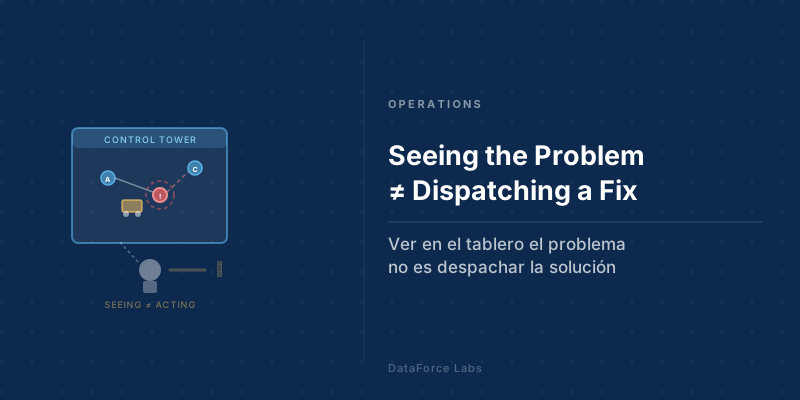
An operations center has no value if the operator can only see the map. Value appears when the system coordinates multiple actors at the same time, manages exceptions, and updates instructions without waiting for the next shift. Seeing the problem on the dashboard is not the same as dispatching the solution.
The same thing happens in logistics. A supplier that can't deliver, a truck stopped in customs, a warehouse without space because it didn't anticipate month-end volume. Each of those events generates a signal that the next actor needs to receive before making their decision. If that signal arrives late, the chain reacts late.
Event-driven architecture, a design where each change in supply chain state generates a notification that other systems can consume immediately, is what allows coordinating that reaction. Without it, the supplier knows the truck stopped, the warehouse doesn't know it, and the customer receives a delivery promise that was already incorrect when it was made.
Supply chain control tower, a tool that centralizes the visibility of the entire chain in real-time, needs that same foundation to truly work. A tower that consolidates only historical data is a passive dashboard. One that consumes events immediately and activates dynamic replanning, the capacity to recalculate routes and allocations when something unexpected happens, is a tool for operation not just for reporting.
Seeing the problem on the dashboard is not the same as dispatching the solution. Accenture's supply chain maturity research found that leaders achieved 23% higher margins than peers between 2019 and 2023. That difference rarely lies in having more data, but in whether the system can translate each signal into a useful decision before the problem reaches the customer.
First identify what events from your chain don't reach anyone until the next day. Then calculate what decisions depend on that signal and how much it costs to process it late. Then evaluate whether your architecture can distribute those events in real-time or only stores them for reports. Finally when reviewing visibility tools, ask how many minutes it takes the system to dispatch the correct response to the right place.