
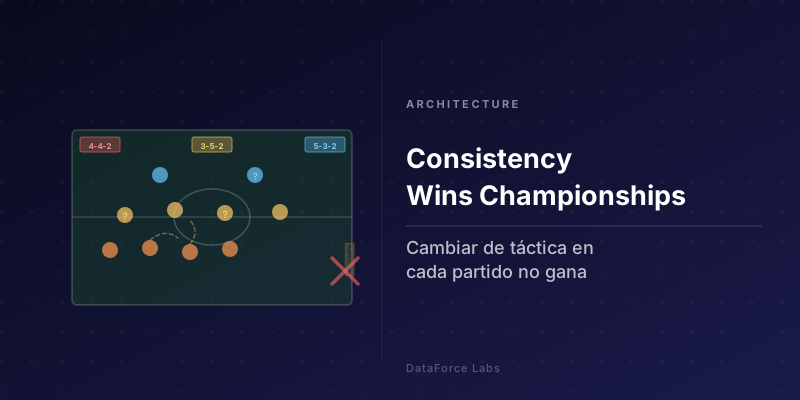
The Team That Changes Tactics Every Game Doesn't Win Championships ⚽
AI Needs a Consistent Operating Model
There's a common belief in financial entities when an artificial intelligence tool arrives. The idea is to connect it to the system as soon as possible and see what happens. The problem isn't the AI, but where it enters the match.
In professional football, the team doesn't rethink its playing system every week based on the report of the opponent of the moment. If it does, the players don't know what role they have and the league is won by whoever is most consistent, not whoever has the best squad.
In banking, the core system serves the same function. It has rules that no provider can alter, like the way a credit is approved or a decision is recorded before regulators. Connecting an AI model directly to the core without isolation means changing it forces touching those rules.
Hexagonal architecture, a design that separates the core of the business from external systems like AI models and digital channels, allows AI to arrive as reinforcement to the scheme. The model takes a defined position and if a better one appears, replacement happens without stopping the championship.
The team also needs rules about who can give orders and who only consults the scoreboard. For risk scoring, credit origination, or regulatory assistants, that difference is critical. CQRS, a pattern that separates intelligent queries from controlled writes, solves that distinction without altering original data.
That separation has regulatory backing. The Federal Reserve's SR-11-7 rule requires that models used in banking can be explained in their purpose and assumptions by any team member, not just those who built them. A system where AI mixes with core without isolation cannot meet that standard.
There's nothing wrong with changing models when a better one arrives. What can't change are the rules of the tournament.
The team that changes tactics every match doesn't win championships. In banking, the architecture that allows innovating with AI without losing regulatory control is not the most modern in the catalog, it's the one that protects the core while models enter as planned signings, not emergencies.
First define what part of the system cannot be ceded to any provider. Then separate queries from decisions that modify state. Then design the entry of each model through an isolated layer with expected behavior. Finally validate that any team member can explain what the model decides and how it gets audited.