
Distributing Load Is Not the Same as Organizing Flow 🚌
Domain Autonomy Needs Shared Contracts
When people hear "data mesh," many leaders assume the solution is giving each department autonomy over its data. What gets forgotten is that autonomy without agreements produces chaos. And chaos doesn't scale.
A well-implemented data mesh doesn't eliminate central order, it redistributes it with clear rules. A poorly implemented one just moves disorder to a different place.
Data mesh is a decentralized architecture that organizes information by business domain (sales, logistics, customers) and treats each dataset as a product that the team must maintain with quality. It was born to break the bottleneck of a central technical team that manages everything.
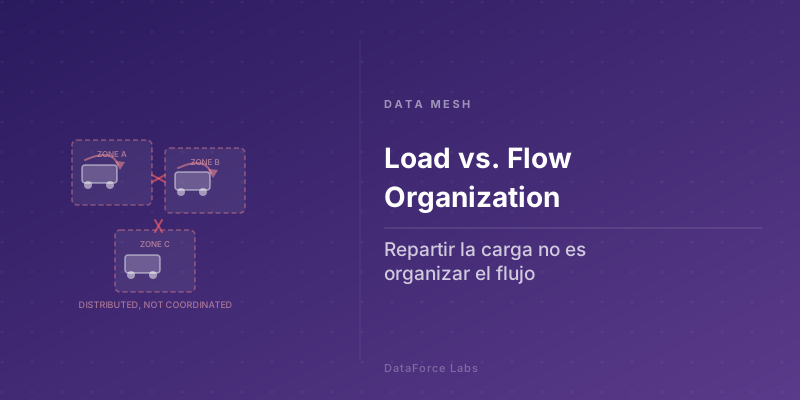
Think about how urban transportation works. A small city operates well with few centralized routes. A large city needs multiple lines per zone. But if each zone designs its routes without a common map or shared connection standards, passengers don't get anywhere. There's no mobility. Just buses going around.
Distributing load is not the same as organizing flow. That's exactly what happens when a company adopts data mesh without governance. Each department generates its own definitions. What sales calls an "active customer" no longer matches what finance calls it. Decisions are made based on data that don't talk to each other.
Data mesh makes sense in large organizations with mature teams in each domain and multiple business units with different data volumes. In those contexts, centralizing everything in one team creates real bottlenecks. Distributing makes sense.
But it doesn't make sense when the organization is just building its first data governance, or when no one has clear ownership. Adding complexity on a fragile foundation doesn't accelerate anything.
The most omitted piece of data mesh is federated governance, which is the set of shared standards that allows domains to be autonomous without becoming incompatible. It's the route map, the common signage, the connection system. Without it, each bus operates at its own pace.
According to the IBM Data Differentiator summarized by IBM Think, 82% of enterprises struggle with data silos that disrupt workflows and 68% of data remains unanalyzed. Data mesh seeks to resolve that. But without structure, it only redistributes the same silos in more places.
First evaluate whether your domains have the maturity to answer for their data. Then define minimum quality agreements before distributing. Then implement one domain at a time. Finally keep a central team that ensures standards are met across the network.