
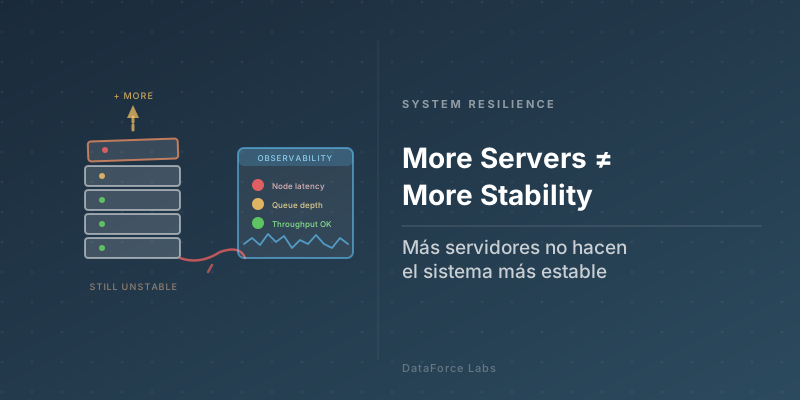
💻 More Servers Don't Make the System More Stable
Additional Inventory Does Not Replace Operational Visibility
When a Colombian company faces a rupture in its supply chain, the most common reaction is to ask for more inventory. If there was a shortage last quarter, stock safety is increased for the next one. The logic seems solid until working capital gets stuck in warehouses while other departments can't find how to pay month commitments.
Resilience in the supply chain is not given by the volume of what you store, but by the quality of decisions made with available information.
Supply chain, which is the complete flow from suppliers to the final customer passing through production, storage, and distribution, has an inherent risk that doesn't disappear by accumulating product. What increases response capacity is diversifying suppliers, identifying bottlenecks, and having visibility over what moves at each point in the flow.
A development team faces something equivalent when a system starts to become unstable. The instinctive reaction is to add more servers. More processing, more memory, more redundancy. But if the underlying problem is fragile design, more servers just scale the error. More servers don't make the system more stable. What changes things is having alerts configured and the capacity to identify at exactly which point in the flow the failure happened.
In the supply chain, those records are real rotation data, delivery times by supplier, and demand levels by reference. Without that information, any decision about how much to order becomes an estimate based on fear of shortage and not on reality.
Working capital is the money the company needs available to operate day-to-day. When that capital gets trapped in stalled inventory, there's visible redundancy but blind decisions. Accenture's research on next-generation supply chain capabilities found that companies with the most mature supply chains achieved 23% higher margins than peers between 2019 and 2023. More servers don't make the system more stable, and more inventory doesn't make the chain more resilient.
First identify which products concentrate shortage risk and which have slow rotation with high stock levels. Then review whether you have real data on delivery times by supplier or if that number only exists in contracts. Then agree with finance what percentage of working capital can be immobilized in inventory without affecting operations. Finally evaluate whether the response to the next shortage will be to add units or understand why it happened.
Does your company decide how much inventory to have based on rotation data or based on the memory of the last problem? 💻