Arquitectura en streaming que aguanta estrategia y operación
Media y Streaming🌐 ES · EN
Catálogo, monetización y moderación deben conversar en cada decisión operativa para que una plataforma de streaming no rompa la experiencia del usuario.
All articles include both versions in their content: Spanish first, then English.
🎬 Arquitectura en streaming que aguanta estrategia y operación
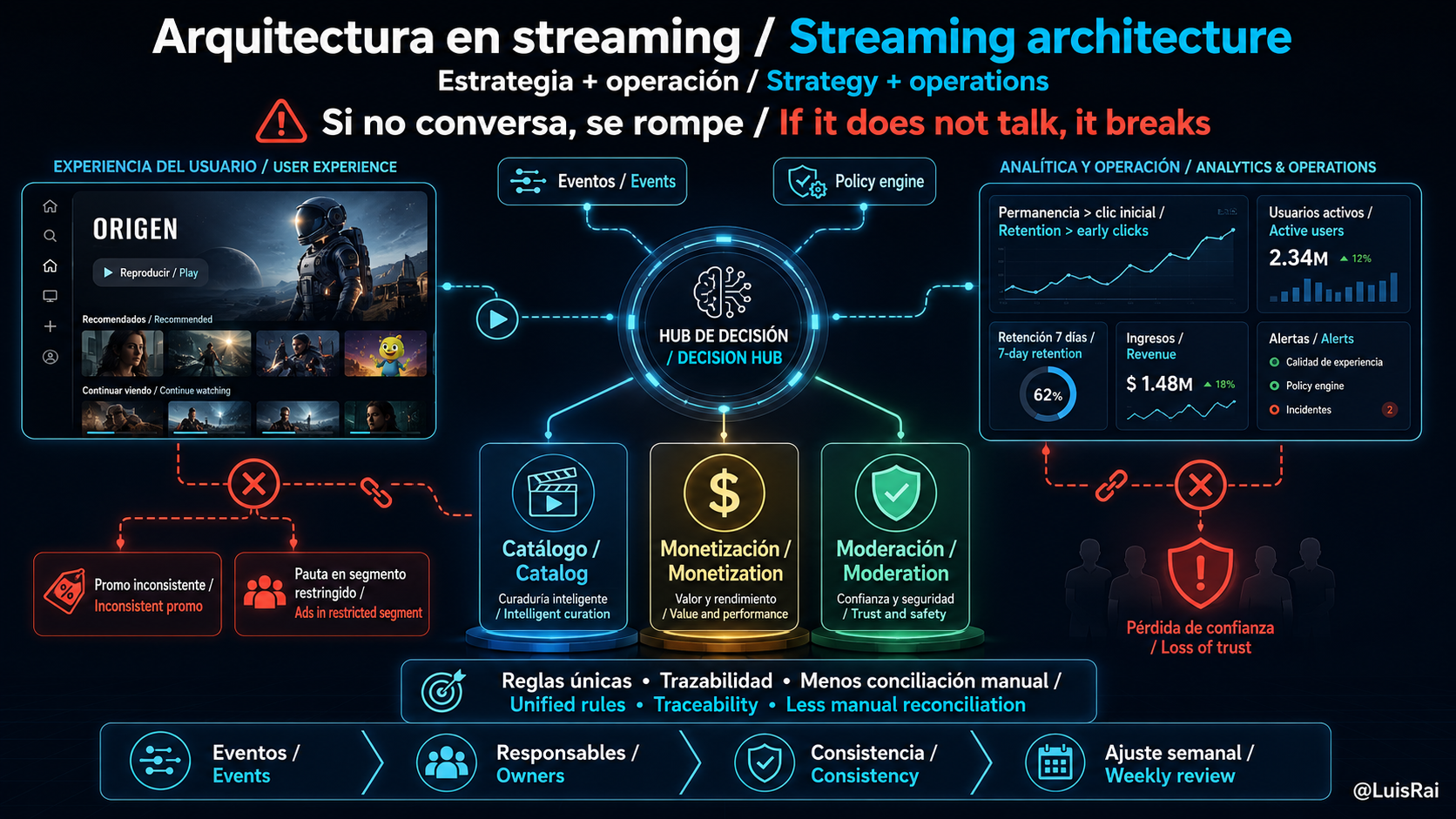
En varias juntas se asume que una plataforma de streaming crece cuando recomienda mejor y vende mejor pauta, pero el tropiezo operativo aparece cuando catálogo, monetización y moderación corren separados y el usuario recibe una experiencia incoherente.
La arquitectura que sostiene crecimiento en streaming obliga a esas tres funciones a conversar en cada decisión operativa, porque si no conversan se rompe y el daño termina en ingreso perdido y soporte saturado.
Arquitectura en streaming significa definir cómo viajan cambios de contenido, reglas comerciales y criterios de confianza entre sistemas, para que analítica lea lo mismo que ejecutó producto y operaciones no cierre el día con conciliaciones manuales.
Primer momento operativo en Colombia: producto activa una promo para retener usuarios del plan básico y comercial cambia reglas de pauta en la misma semana, pero catálogo mantiene etiquetas antiguas por restricción de tiempo. Entonces sube el clic de campaña, baja la reproducción efectiva y soporte recibe reclamos por promesas que no coinciden.
Segundo momento operativo: confianza y seguridad ajusta una clasificación por riesgo de contenido y esa decisión no llega completa al motor de ingresos. Entonces se sirve publicidad en segmentos restringidos, legal pide explicaciones, operaciones pausa inventario y la reunión se va a reconstruir el rastro.
Netflix documenta que su sistema de recomendación prioriza satisfacción de largo plazo sobre reacción inmediata. Ese hallazgo cambia una decisión concreta para liderazgo: medir solo clic temprano no alcanza cuando el objetivo real es permanencia y calidad de sesión. Si no conversa se rompe y el tablero puede mostrar mejora mientras la experiencia se deteriora.
Dos tecnicismos bastan para bajar esto a ejecución. Event driven es una arquitectura que reacciona a hechos como alta de título, cambio de regla o bloqueo de cuenta para sincronizar sistemas sin llamadas manuales en cadena. Policy engine es un servicio que aplica reglas de negocio y confianza de forma consistente antes de publicar una acción.
Una plataforma pequeña no necesita la complejidad de una operación global, pero sí necesita trazabilidad mínima entre contenido, ingresos y moderación. Cuando esa base falta, el costo aparece en retrabajo y horas perdidas en conciliaciones.
Primero definan eventos y responsables compartidos; luego conecten catálogo, monetización y moderación sobre reglas únicas; después midan permanencia junto con consistencia operativa y no solo clic inicial; por último revisen cada semana dónde se rompió el flujo y quién decide el ajuste antes de la siguiente campaña.
🎬 Streaming architecture that holds strategy and operations
In many leadership meetings, the assumption is that a streaming platform grows by recommending better and selling more advertising, but the operational stumble appears when catalog, monetization, and moderation run separately and the user receives an incoherent experience.
The architecture that sustains growth in streaming requires those three functions to communicate on every operational decision, because when they do not communicate the system breaks and the damage ends in lost revenue and saturated support.
Streaming architecture means defining how content changes, commercial rules, and trust criteria travel between systems, so that analytics reads the same state that product executed and operations does not close the day with manual reconciliations.
First operational moment in Colombia: product activates a promotion to retain basic plan users and commercial changes advertising rules in the same week, but catalog keeps old labels due to time constraints. Click rate on the campaign goes up, effective playback goes down, and support receives complaints about promises that do not match.
Second operational moment: trust and safety adjusts a content risk classification and that decision does not reach the revenue engine fully. Advertising is then served in restricted segments, legal asks for explanations, operations pauses inventory, and the meeting becomes a forensic reconstruction.
Netflix documents that its recommendation system prioritizes long-term member satisfaction over immediate reaction. That finding changes a concrete decision for leadership: measuring only early clicks is not enough when the real objective is session quality and retention. If the system does not communicate, it breaks, and the dashboard can show improvement while the experience deteriorates.
Two technical concepts are enough to bring this into execution. Event driven is an architecture that reacts to facts such as title addition, rule change, or account block to synchronize systems without manual chained calls. Policy engine is a service that applies business and trust rules consistently before publishing an action.
A small platform does not need the complexity of a global operation, but it does need minimum traceability between content, revenue, and moderation. When that foundation is missing, the cost appears in rework and hours lost in reconciliations.
First define shared events and ownership; then connect catalog, monetization, and moderation on unified rules; next measure retention alongside operational consistency rather than only early clicks; finally review each week where the flow broke and who decides the adjustment before the next campaign.
Share this article
Send it to someone who should read it, or save the link for later.