
🗺️ La agenda no es la carretera
La computación cuántica lleva meses posicionada en el discurso público colombiano como si ya fuera una tecnología operativa, con hardware funcional listo para integrarse en procesos productivos reales. Los comunicados hablan de liderazgo y abanderamiento con la misma naturalidad con que uno hablaría de una infraestructura disponible hoy. A ese salto entre el anuncio y la realidad técnica le falta sustento.
Poner la computación cuántica en la agenda nacional es una decisión legítima; confundirlo con tenerla como infraestructura desplegada genera expectativas que el campo todavía no puede satisfacer.
Para entender dónde está realmente este campo hay que revisar el hardware. Un qubit es la unidad básica de procesamiento en un computador cuántico, análogo al bit clásico pero capaz de representar simultáneamente múltiples estados a través de la superposición, propiedad que permite resolver ciertos problemas computacionalmente intensos de formas que el cómputo clásico no puede emular con igual eficiencia. Los qubits son, sin embargo, extremadamente sensibles a cualquier perturbación del entorno; el calor, la vibración y la interferencia electromagnética los desestabilizan en microsegundos, lo que convierte el aislamiento criogénico y el control de ruido en requisitos de ingeniería que todavía limitan la escala de estos sistemas.
IBM, el fabricante que opera hoy la mayor flota de computadores cuánticos accesibles por internet, disponía en 2025 de procesadores Eagle a 127 qubits, Heron r1 a 133 qubits y Heron r2 y r3 a 156 qubits cada uno, con 28 sistemas de más de 100 qubits activos desde 2022 y más de 3,6 billones de circuitos ejecutados en total. Ese avance es extraordinario para una tecnología que en 2016 era apenas un procesador de cinco qubits disponible en la nube.
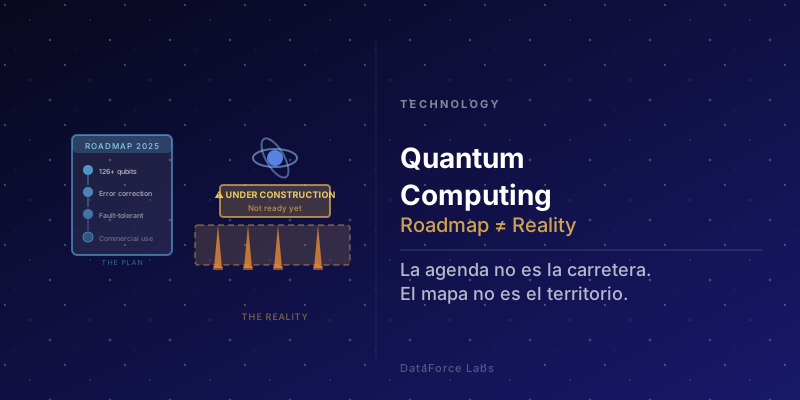
La hoja de ruta de IBM fija la ventaja cuántica, que es el punto donde un procesador cuántico supera de forma consistente a los mejores algoritmos clásicos en un problema de valor práctico real, como meta para antes de finales de 2026. El primer computador cuántico tolerante a fallas a gran escala tiene fecha proyectada en 2029. Tolerante a fallas significa capaz de detectar y corregir automáticamente los errores inevitables en qubits reales sin detener la ejecución, y esa capacidad es el requisito técnico que separa un prototipo útil en nichos de una infraestructura de propósito general. La agenda está trazada con claridad; la carretera tiene tramos en construcción.
En junio de 2024, la Asamblea General de la ONU proclamó 2025 como el Año Internacional de la Ciencia y Tecnología Cuánticas, reconociendo el centenario del desarrollo inicial de la mecánica cuántica. El propósito declarado de esa iniciativa fue aumentar la conciencia pública sobre la importancia del campo y sus aplicaciones, no certificar adopción masiva. Durante ese año los países participantes pasaron de preguntarse si sumarse a la agenda cuántica a preguntarse cómo construir programas coordinados, creíbles y con impacto real; IBM contribuyó a ese esfuerzo en el Foro de Ciencia, Tecnología e Innovación de la ONU para los Objetivos de Desarrollo Sostenible, compartiendo rutas prácticas para el desarrollo de talento y la construcción de ecosistema.
Piensa en dos directores de tecnología que asesoran sus juntas en empresas medianas en Bogotá. El primero escuchó el discurso político e incluyó en su presentación la integración de computación cuántica en la plataforma de optimización logística para el siguiente año fiscal. La junta aprobó porque sonaba estratégico y alineado con la agenda nacional.
El segundo llevó una pregunta diferente antes de producir cualquier propuesta. ¿En cuál problema concreto de nuestra operación esperarías que un algoritmo cuántico supere al solver clásico que ya usamos? ¿Con qué nivel de corrección de errores cuánticos debería operar el sistema para que el resultado sea confiable? La corrección de errores cuánticos es la técnica que detecta y compensa los fallos inevitables en qubits reales, y es exactamente el requisito que IBM identifica como el umbral pendiente antes de que la computación cuántica sea útil a escala general.
La primera propuesta no tiene hoy el hardware que la soporte. La segunda construye la capacidad para evaluar con precisión cuándo ese hardware sí estará disponible y qué necesita el equipo para aprovecharlo cuando llegue. La agenda no es la carretera, y esa diferencia determina si el dinero invertido en exploración cuántica produce aprendizaje estratégico o un proyecto que no puede ejecutarse.
Colombia tiene señales reales de política pública en tecnologías cuánticas, con convocatorias en metrología, sensores, energía y líneas exploratorias en desminado. Construir infraestructura de conocimiento humano hoy es la decisión estratégica correcta; esa base estará lista para operar cuando el hardware madure. El Qiskit Global Summer School de IBM en 2025 reunió más de ocho mil inscritos de 115 países, incluidos participantes latinoamericanos con acceso a computadores cuánticos reales por la nube, y el Qiskit Fall Fest del mismo año movilizó más de 32 mil participantes de 49 países con crecimiento del triple respecto al año anterior.
Lo que no es carretera es declarar que ya se llegó. Cuando el discurso político salta de construir capacidades a afirmar implícitamente que Colombia ya lidera una tecnología cuya fase madura IBM proyecta para 2029, el problema no es la ambición sino la imprecisión. Los equipos que toman decisiones presupuestales basados en esa imprecisión terminan con planes que el mercado no puede ejecutar.
Cuando el e-commerce llegó a Colombia a finales de los noventa, varias empresas diseñaron estrategias completas para vender en línea cuando la cobertura de internet residencial era mínima y los sistemas de pago digital prácticamente no existían. El GPS señalaba el destino de la economía digital; la vía que conectaba con él estaba sin pavimentar. Las empresas que sobrevivieron no fueron las que creyeron al anuncio tal como llegó; fueron las que entendieron exactamente cuánto faltaba por recorrer y qué había que edificar mientras tanto.
Recursos recomendados
- IBM Quantum. Hardware actual y hoja de ruta oficial (referencia técnica) https://www.ibm.com/quantum/technology
- International Year of Quantum Science and Technology 2025. Sitio oficial del IYQ (portal de referencia) https://quantum2025.org/about/
- IBM Quantum Blog. A look back at the International Year of Quantum (informe de comunidad) https://www.ibm.com/quantum/blog/international-year-of-quantum
Primero revisa la hoja de ruta pública de IBM para saber cuándo el hardware tolerante a fallas estará disponible, luego identifica si hay en tu organización algún problema cuya complejidad lo haría candidato a ventaja cuántica, después invierte en formación en algoritmos cuánticos porque esa capacidad puede construirse hoy con recursos abiertos, por último sigue el Quantum Advantage Tracker de IBM para distinguir avances verificados de anuncios sin respaldo experimental.
¿En tu empresa o en tu sector ya hay alguien mapeando qué tipo de problemas podrían beneficiarse de computación cuántica cuando el hardware madure, o la conversación todavía está al nivel del titular? 🗺️
Versión en inglés
🗺️ The Agenda Is Not the Road
Quantum computing has spent months positioned in Colombian public discourse as if it were already an operational technology, with functioning hardware ready to integrate into actual productive processes. Communications talk about leadership and championing with the same naturalness one would speak of infrastructure available today. That jump between the announcement and technical reality lacks foundation.
Putting quantum computing on the national agenda is a legitimate decision; confusing it with having it as deployed infrastructure generates expectations that the field still can't satisfy.
To understand where this field really is you need to review the hardware. A qubit is the basic processing unit in a quantum computer, analogous to the classical bit but capable of simultaneously representing multiple states through superposition, a property that allows solving certain computationally intensive problems in ways that classical computing can't emulate with equal efficiency. Qubits are, however, extremely sensitive to any environmental perturbation; heat, vibration, and electromagnetic interference destabilize them in microseconds, which turns cryogenic isolation and noise control into engineering requirements that still limit the scale of these systems.
IBM, the manufacturer operating today the largest fleet of quantum computers accessible over the internet, had available in 2025 Eagle processors at 127 qubits, Heron r1 at 133 qubits, and Heron r2 and r3 at 156 qubits each, with 28 systems of more than 100 qubits active since 2022 and more than 3.6 trillion circuits executed in total. That advance is extraordinary for a technology that in 2016 was just a five-qubit processor available in the cloud.
IBM's roadmap sets quantum advantage, which is the point where a quantum processor consistently surpasses the best classical algorithms in a real practical value problem, as a goal before end of 2026. The first fault-tolerant quantum computer at large scale has a projected date in 2029. Fault-tolerant means capable of automatically detecting and correcting inevitable errors in real qubits without stopping execution, and that capability is the technical requirement separating a prototype useful in niches from infrastructure for general purpose. The agenda is clearly traced; the road has sections under construction.
In June 2024, the UN General Assembly proclaimed 2025 as the International Year of Quantum Science and Technology, recognizing the centennial of initial development of quantum mechanics. The stated purpose of that initiative was to increase public awareness of the field's importance and applications, not certify massive adoption. During that year countries shifted from asking whether to join the quantum agenda to asking how to build coordinated, credible programs with real impact; IBM contributed to that effort at the UN Science, Technology, and Innovation Forum for the Sustainable Development Goals, sharing practical routes for talent development and ecosystem building.
Think of two CIOs advising their boards at mid-sized companies in Bogotá. The first heard the political discourse and included integrating quantum computing into the logistics optimization platform in next fiscal year. The board approved because it sounded strategic and aligned with the national agenda.
The second brought a different question before producing any proposal. What concrete problem in our operations would you expect a quantum algorithm to outperform the classical solver we already use? What level of quantum error correction would the system need to operate so the result is reliable? Quantum error correction is the technique detecting and compensating inevitable qubit failures, and it's exactly the requirement IBM identifies as the pending threshold before quantum computing is useful at general scale.
The first proposal lacks the hardware to support it today. The second builds the capacity to evaluate with precision when that hardware will be available and what the team needs to take advantage of it when it arrives. The agenda is not the road, and that difference determines whether money invested in quantum exploration produces strategic learning or a project that can't be executed.
Colombia has real signals of public policy in quantum technologies, with calls in metrology, sensors, energy, and exploratory lines in mine clearing. Building human knowledge infrastructure today is the correct strategic decision; that foundation will be ready to operate when hardware matures. IBM's 2025 Qiskit Global Summer School brought in more than eight thousand attendees from 115 countries, including Latin American participants with access to real quantum computers through the cloud, and the same year's Qiskit Fall Fest mobilized more than 32 thousand participants from 49 countries with triple growth versus the prior year.
What is not road is declaring that you've already arrived. When political discourse jumps from building capacities to implicitly stating that Colombia already leads a technology whose mature phase IBM projects for 2029, the problem isn't ambition but imprecision. Teams making budgetary decisions based on that imprecision end up with plans the market can't execute.
When e-commerce arrived in Colombia in the late nineties, several companies designed complete strategies for selling online when residential internet coverage was minimal and digital payment systems practically didn't exist. The GPS pointed to the destination of the digital economy; the highway connecting to it was unpaved. Companies that survived weren't the ones that believed the announcement as it arrived; they were the ones that understood exactly how much was left to travel and what needed building in the meantime.
Recommended Resources
- IBM Quantum. Current hardware and official roadmap (technical reference) https://www.ibm.com/quantum/technology
- International Year of Quantum Science and Technology 2025. Official IYQ website (reference portal) https://quantum2025.org/about/
- IBM Quantum Blog. A look back at the International Year of Quantum (community report) https://www.ibm.com/quantum/blog/international-year-of-quantum
First review IBM's public roadmap to know when fault-tolerant hardware will be available, then identify whether there's any problem in your organization whose complexity would make it a candidate for quantum advantage, then invest in formation in quantum algorithms because that capability can be built today with open resources, finally follow IBM's Quantum Advantage Tracker to distinguish verified advances from announcements without experimental backing.
In your company or sector is anyone already mapping what types of problems could benefit from quantum computing when hardware matures, or is the conversation still at the headline level? 🗺️