
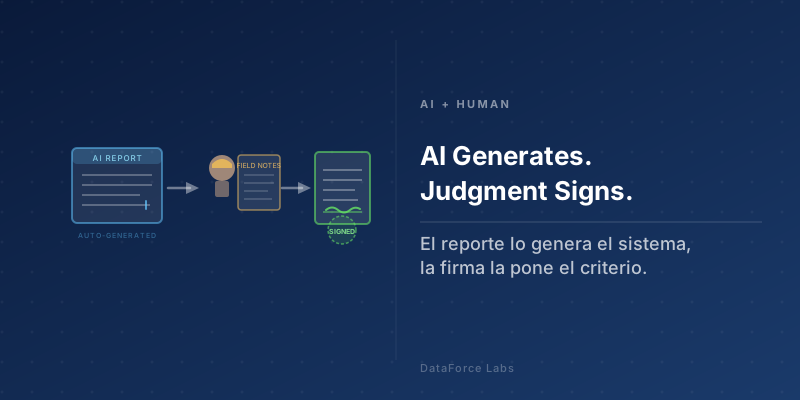
🏗️ El reporte lo genera el sistema, la firma la pone el criterio
La conversación en las industrias colombianas lleva meses girando en el mismo punto: si una herramienta de GenAI puede producir informes de seguimiento, redactar procedimientos documentados o consultar en segundos el marco normativo aplicable, entonces el especialista en SST, el analista de gestión humana o el profesional de cumplimiento ya sobran. La conversación mezcla dos cosas que funcionan de forma distinta.
La IA generativa no reemplaza las labores administrativas transversales; reemplaza las tareas dentro de esas labores que no requieren juicio profesional.
En un proyecto de construcción industrial, un sistema BIM (software que modela el diseño y los cálculos de una edificación en tres dimensiones antes de iniciar la obra) genera planos, memorias de cálculo y cronogramas con velocidad formal. Pero es el residente de obra quien camina el terreno y detecta que el perfil de suelo real no coincide con el del estudio geotécnico. El plano lo genera el sistema. La decisión de cimentar distinto la toma quien conoce el terreno.
Las herramientas de IA generativa (sistemas que producen texto o documentos a partir de instrucciones en lenguaje natural, disponibles como servicios que el proveedor opera por internet) pueden ejecutar tareas de cumplimiento con bajo riesgo decisional: el borrador de un procedimiento a partir de una plantilla, el informe de indicadores desde una base estructurada, las alertas de vencimiento documental, el seguimiento de compromisos en planes de acción y la consulta rápida de normativa aplicable. Estas actividades consumen tiempo real en cualquier área transversal de una empresa industrial y son candidatas reales a automatización parcial.
Lo que ese mismo sistema no puede hacer tiene otro orden. No puede interpretar por qué el indicador de accidentalidad marcó cero tres meses seguidos cuando la operación se modificó sin actualizar el reporte. No puede investigar la causa raíz de una no conformidad que en papel parece error de etiquetado pero en campo responde a un cambio de proveedor no autorizado. No puede asumir responsabilidad legal en una investigación de accidente grave ni detener una actividad cuando la evidencia de campo contradice lo que dice el procedimiento documentado.
Piensa en dos profesionales de SST en una empresa manufacturera del Valle del Cauca ante la misma investigación de accidente de trabajo. La primera usa la herramienta: el informe sale en doce minutos con causas básicas identificadas, plan de acción y matrices actualizadas. Cumple formalmente con la Resolución 0312 de 2019, que es la norma que establece los estándares mínimos del Sistema de Gestión de Seguridad y Salud en el Trabajo en Colombia. Firma, envía y continúa con el siguiente caso.
La segunda usa ese informe como punto de partida, va al área y habla con el supervisor del turno. Encuentra que la tarea donde ocurrió el accidente no estaba incluida en el Análisis de Puesto de Trabajo del cargo afectado, que es el documento del SG-SST donde se registran las tareas, los riesgos asociados y los controles para cada posición. La causa raíz no es el EPP: es una brecha entre el procedimiento documentado y la operación real. El informe final tiene causas distintas y un plan de acción diferente. Ante una visita del Ministerio del Trabajo o una demanda laboral, solo uno de esos dos documentos protege a la empresa y al trabajador. El reporte lo genera el sistema, la firma la pone el criterio.
Este patrón tiene historia. Cuando los sistemas ERP (plataformas que integran contabilidad, compras, nómina e inventario en un solo sistema) llegaron a la industria colombiana en los primeros años del 2000, la predicción era que el software reemplazaría a los auxiliares contables, analistas de compras y coordinadores de nómina. Las empresas que redujeron sus equipos antes de que alguien aprendiera a auditar lo que el sistema producía encontraron meses después el inventario descuadrado o la nómina liquidada con errores de parametrización. La herramienta procesaba transacciones a velocidad; lo que no detectaba era cuándo la lógica que le habían ingresado estaba equivocada.
La Organización Internacional del Trabajo publicó en agosto de 2023 un análisis global sobre IA generativa y empleo que concluyó que el efecto dominante de la tecnología será aumentar las capacidades de las ocupaciones, no automatizarlas. El informe señala que los roles de tipo clerical, que incluyen buena parte de las tareas de registro, seguimiento y redacción dentro de las labores administrativas, tienen la mayor exposición; pero que el resultado final depende de si quien ocupa esos roles puede asumir las funciones de mayor exigencia dentro del mismo cargo.
El McKinsey Global Institute estimó en julio de 2023 que la IA generativa eleva a 29,5% la proporción de actividades laborales automatizables para 2030, frente al 21,5% proyectado sin ella. El estudio distingue los roles de soporte de oficina, con mayor riesgo de contracción, de los perfiles de negocios y legal, donde el escenario no es eliminación sino cambio de composición de tareas hacia mayor peso en análisis, criterio y decisión. Esa distinción aplica directamente a los perfiles transversales de una industria colombiana.
En una empresa industrial, quien solo redacta informes rutinarios y actualiza matrices sin contexto de campo está en el segmento de mayor exposición a la automatización. Quien investiga causas en sitio, interpreta resultados con conocimiento del proceso, toma decisiones con responsabilidad normativa y firma documentos que tienen consecuencias legales ocupa el segmento que ninguna herramienta puede reemplazar porque ninguna puede asumir las consecuencias de lo que genera. El reporte lo genera el sistema, la firma la pone el criterio.
Recursos recomendados
- Organización Internacional del Trabajo. Generative AI and Jobs - A global analysis of potential effects on job quantity and quality (informe) https://www.ilo.org/publications/generative-ai-and-jobs-global-analysis-potential-effects-job-quantity-and
- McKinsey Global Institute. Generative AI and the future of work in America (informe) https://www.mckinsey.com/mgi/our-research/generative-ai-and-the-future-of-work-in-america
- MinTrabajo Colombia. Resolución 0312 de 2019 - Estándares mínimos del SG-SST (referencia normativa) https://www.mintrabajo.gov.co/documents/20147/59995826/Resolucion+0312-2019-+Estandares+minimos+del+Sistema+de+la+Seguridad+y+Salud.pdf
Primero identifica en tu rol qué tareas son de registro, redacción o seguimiento estructurado que un sistema podría absorber, luego experimenta delegando esas actividades y mide el tiempo que recuperas, después orienta ese tiempo a trabajo de campo, investigación causal y decisiones con responsabilidad directa, por último revisa el análisis del ILO sobre IA y empleo para contrastar la exposición real de tu perfil con la narrativa que circula en las reuniones de tu empresa.
En tu empresa, ¿qué área transversal ha comenzado a usar herramientas de IA para sus informes y cómo están validando que el resultado es correcto antes de firmarlo? 🏗️
Versión en inglés
🏗️ The System Generates the Report; Judgment Provides the Signature
The conversation in Colombian industries has been going in the same direction for months: if a GenAI tool can produce monitoring reports, draft documented procedures, or consult the applicable regulatory framework in seconds, then the occupational health specialist, the human resources analyst, or the compliance professional are no longer needed. The conversation mixes two things that work differently.
Generative AI doesn't replace transversal administrative work; it replaces tasks within that work that don't require professional judgment.
In an industrial construction project, a BIM system (software that models the design and calculations of a building in three dimensions before work starts) generates plans, calculation reports, and schedules with formal speed. But it's the site resident engineer who walks the land and detects that the real soil profile doesn't match the geotechnical study. The system generates the plan. The decision to set foundations differently is made by someone who knows the terrain.
Generative AI tools (systems that produce text or documents from natural language instructions, available as services the provider operates over the internet) can execute compliance tasks with low decision risk: drafting a procedure from a template, reporting indicators from structured data, alerts for document expiration, tracking commitments in action plans, and quick consultation of applicable regulations. These activities consume real time in any transversal area of an industrial company and are real candidates for partial automation.
What that same system can't do falls in another category. It can't interpret why the accident rate indicator shows zero three months straight when operations changed without updating the report. It can't investigate the root cause of a non-conformity that on paper seems a labeling error but in the field stems from an unauthorized supplier change. It can't assume legal responsibility in a serious accident investigation or stop an activity when field evidence contradicts what the documented procedure says.
Think of two occupational health professionals in a manufacturing company in Valle del Cauca facing the same work accident investigation. The first uses the tool: the report comes out in twelve minutes with basic causes identified, action plan, and updated matrices. It formally meets Resolution 0312 of 2019, which is the regulation establishing minimum standards of the Occupational Health and Safety Management System in Colombia. Signs, sends, and moves to the next case.
The second uses that report as a starting point, goes to the area, and talks with the shift supervisor. They find that the task where the accident happened wasn't included in the Job Analysis for the affected position, which is the document where tasks, associated risks, and controls for each position are recorded. The root cause isn't PPE: it's a gap between the documented procedure and actual operations. The final report has different causes and a different action plan. Before a Ministry of Labor visit or a labor lawsuit, only one of those two documents protects the company and the worker. The system generates the report; judgment provides the signature.
This pattern has history. When ERP systems (platforms that integrate accounting, purchasing, payroll, and inventory in a single system) arrived in Colombian industry in the early 2000s, the prediction was that software would replace accounting assistants, purchasing analysts, and payroll coordinators. Companies that reduced their teams before anyone learned to audit what the system produced found months later their inventory was misaligned or payroll was calculated with parameterization errors. The tool processed transactions at speed; what it didn't detect was when the logic they'd entered was wrong.
The International Labour Organization published in August 2023 a global analysis on generative AI and employment concluding that the dominant effect of technology will be to enhance job capabilities, not automate them. The report notes that clerical roles, which include much of the recording, monitoring, and drafting within administrative tasks, have the highest exposure; but that the final outcome depends on whether whoever holds those roles can assume higher-demand functions within the same position.
The McKinsey Global Institute estimated in July 2023 that generative AI raises to 29.5% the proportion of labor activities automatable by 2030, versus the 21.5% projected without it. The study distinguishes office support roles, with greater contraction risk, from business and legal profiles, where the scenario isn't elimination but change in task composition toward greater weight in analysis, judgment, and decision with direct consequence. That distinction applies directly to transversal profiles in a Colombian industrial company.
In an industrial company, whoever only drafts routine reports and updates matrices without field context is in the segment with greatest automation exposure. Whoever investigates causes on site, interprets results with process knowledge, makes decisions with regulatory responsibility, and signs documents that have legal consequences occupies the segment no tool can replace because no system can assume the consequences of what it generates. The system generates the report; judgment provides the signature.
Recommended Resources
- International Labour Organization. Generative AI and Jobs - A global analysis of potential effects on job quantity and quality (report) https://www.ilo.org/publications/generative-ai-and-jobs-global-analysis-potential-effects-job-quantity-and
- McKinsey Global Institute. Generative AI and the future of work in America (report) https://www.mckinsey.com/mgi/our-research/generative-ai-and-the-future-of-work-in-america
- MinTrabajo Colombia. Resolution 0312 of 2019 - Minimum standards of the Occupational Health and Safety Management System (regulatory reference) https://www.mintrabajo.gov.co/documents/20147/59995826/Resolucion+0312-2019-+Estandares+minimos+del+Sistema+de+la+Seguridad+y+Salud.pdf
[YouTube embed: Generative AI and the Nature of Work (AI & the Future of Work)]
First identify in your role what tasks are recording, drafting, or structured monitoring that a system could absorb, then experiment delegating those activities and measure the time you recover, then direct that time toward field work, causal investigation, and decisions with direct responsibility, finally review the ILO analysis on AI and employment to contrast the real exposure of your profile with the narrative circulating in your company meetings.
In your company, which transversal area has started using AI tools for its reports and how are they validating that the result is correct before signing it? 🏗️