
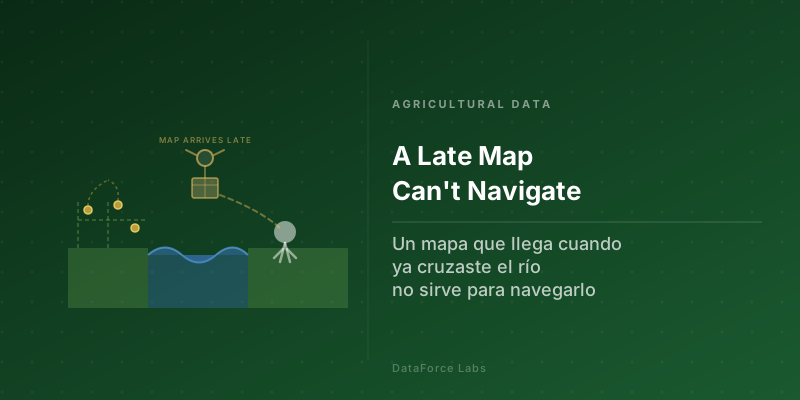
Un mapa que llega cuando ya cruzaste el río no sirve para navegarlo 🗺️
La IA en agroindustria se asocia a reportes que describen cuánto se cosechó, qué calidad tuvo el lote o cuánta merma hubo en el último trimestre. El problema no es que esos reportes sean inexactos, es que llegan tarde. En el campo, el valor no está en el resumen histórico sino en la señal que llega antes de que el daño sea irreversible.
Imagina un equipo de exploración en terreno disperso con cinco instrumentos separados, temperatura, humedad del suelo, estado de los equipos, posición de los vehículos y calidad del lote en tránsito. Cada uno funciona por su cuenta. Alguien debe leerlos uno a uno cada mañana para armar el panorama del día. Cuando la decisión llega, la helada ya pasó, el motor ya se recalentó o la fruta ya comenzó a perder su punto en la cadena de frío.
Esa es la tensión del agronegocio moderno. La operación es dispersa por naturaleza, fincas, camiones, frigoríficos y bodegas en puntos distintos, pero las decisiones deben tomarse de forma central y con información actualizada. Cuando los sistemas que miden clima, producción, logística y calidad no se comunican, la dirección opera con mapas viejos y actúa cuando el margen para recuperar el lote ya se cerró.
La arquitectura orientada a eventos, donde cada sensor publica un cambio y quienes necesitan reaccionar lo reciben sin pedirlo, reduce el tiempo entre la señal y la acción. Si el sensor de temperatura en el camión frigorífico detecta un desvío, el sistema de trazabilidad actualiza el estado del lote antes de que llegue al centro de acopio. Proyectos de IA agrícola apoyados por IBM en comunidades rurales reportan aumentos de productividad de hasta el 40% cuando la información climática y de producción llega a tiempo (IBM, 2024).
El pipeline de datos, la ruta por la que esa señal viaja desde el sensor en campo hasta el modelo que decide, es el equivalente a conectar todos los instrumentos del equipo de exploración entre sí. Cuando predicción de cosecha, mantenimiento de maquinaria y trazabilidad de lotes comparten ese pipeline, el equipo central deja de esperar el consolidado del día siguiente para actuar.
Un mapa que llega cuando ya cruzaste el río no sirve para navegarlo.
Primero, instrumentar los puntos críticos de la operación para que generen eventos en tiempo real. Luego, construir el pipeline que lleva esas señales a los modelos que actúan. Después, separar cosecha, calidad y logística en componentes que evolucionen sin bloquearse entre sí. Por último, medir no la cantidad de datos capturados sino los días que se redujo entre el evento y la decisión.
Versión en inglés
A Map That Arrives After You've Crossed the River Doesn't Help You Navigate 🗺️
AI in agribusiness is associated with reports describing how much was harvested, what quality the batch had, or how much was lost in the last quarter. The problem is not that those reports are inaccurate, it's that they arrive late. In the field, value doesn't lie in the historical summary but in the signal that arrives before damage becomes irreversible.
Imagine an exploration team in dispersed terrain with five separate instruments: temperature, soil moisture, equipment state, vehicle position, and lot quality in transit. Each operates on its own. Someone must read them one by one each morning to build the day's picture. When the decision arrives, the frost has already passed, the motor already overheated, or the fruit already started losing its point in the cold chain.
That's the tension of modern agribusiness. Operations are dispersed by nature—farms, trucks, refrigerated facilities, and warehouses at different points—but decisions must be made centrally and with updated information. When the systems measuring climate, production, logistics, and quality don't communicate, leadership operates with old maps and acts when the margin to recover the lot has already closed.
Event-driven architecture, where each sensor publishes a change and those needing to react receive it without asking, reduces the time between signal and action. If the temperature sensor in the refrigerated truck detects a deviation, the traceability system updates the lot state before it reaches the packing center. Agricultural AI projects supported by IBM in rural communities report productivity increases of up to 40% when climate and production information arrives on time (IBM, 2024).
Data pipeline, the route that signal travels from the field sensor to the model that decides, is the equivalent of connecting all the exploration team's instruments to each other. When crop prediction, equipment maintenance, and lot traceability share that pipeline, the central team stops waiting for the next day's consolidated report to act.
A map that arrives after you've crossed the river doesn't help you navigate.
First instrument the critical points of operations so they generate real-time events. Then build the pipeline that carries those signals to the models that act. Then separate harvest, quality, and logistics into components that evolve without blocking each other. Finally measure not the quantity of data captured but the days reduced between event and decision.