
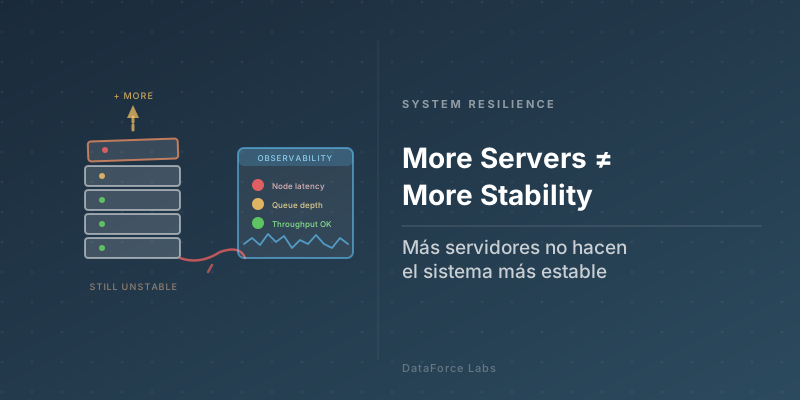
💻 Más servidores no hacen el sistema más estable
Cuando una empresa colombiana enfrenta una ruptura en su cadena de abastecimiento, la reacción más común es pedir más inventario. Si hubo desabasto el trimestre anterior, se aumenta el stock de seguridad para el siguiente. La lógica parece sólida hasta que el capital de trabajo queda inmovilizado en bodegas mientras otras áreas no encuentran cómo pagar compromisos del mes.
La resiliencia en la cadena de abastecimiento no la da el volumen de lo que se guarda, sino la calidad de las decisiones que se toman con la información disponible.
La supply chain, que es el flujo completo desde los proveedores hasta el cliente final pasando por producción, almacenamiento y distribución, tiene un riesgo inherente que no desaparece acumulando producto. Lo que aumenta la capacidad de respuesta es diversificar proveedores, identificar cuellos de botella y tener visibilidad sobre lo que se mueve en cada punto del flujo.
Un equipo de desarrollo enfrenta algo equivalente cuando un sistema empieza a volverse inestable. La reacción instintiva es agregar más servidores. Más procesamiento, más memoria, más redundancia. Pero si el problema de fondo es un diseño frágil, más servidores solo escalan el error. Más servidores no hacen el sistema más estable. Lo que cambia las cosas es tener alertas configuradas y la capacidad de identificar en qué punto exacto del flujo ocurrió la falla.
En la cadena de abastecimiento, esos registros son los datos de rotación real, tiempos de entrega por proveedor y niveles de demanda por referencia. Sin esa información, cualquier decisión sobre cuánto pedir se convierte en una estimación basada en el miedo al desabasto y no en la realidad.
El capital de trabajo es el dinero que la empresa necesita disponible para operar día a día. Cuando ese capital queda atrapado en inventario parado, hay redundancia visible pero decisiones ciegas. Según IBM Think, organizaciones con capacidades avanzadas de gestión de cadena de abastecimiento son 23% más rentables que sus pares. Más servidores no hacen el sistema más estable, y más inventario no hace la cadena más resiliente.
Primero identifique cuáles productos concentran riesgo de desabasto y cuáles tienen rotación lenta con alto nivel de stock. Luego revise si tiene datos reales de tiempos de entrega por proveedor o si ese número solo existe en contratos. Después acuerde con finanzas qué porcentaje del capital de trabajo puede estar inmovilizado en inventario sin afectar la operación. Por último evalúe si la respuesta al próximo desabasto será agregar unidades o entender por qué ocurrió.
¿Su empresa decide cuánto inventario tener con datos de rotación o con el recuerdo del último problema? 💻
Versión en inglés
💻 More Servers Don't Make the System More Stable
When a Colombian company faces a rupture in its supply chain, the most common reaction is to ask for more inventory. If there was a shortage last quarter, stock safety is increased for the next one. The logic seems solid until working capital gets stuck in warehouses while other departments can't find how to pay month commitments.
Resilience in the supply chain is not given by the volume of what you store, but by the quality of decisions made with available information.
Supply chain, which is the complete flow from suppliers to the final customer passing through production, storage, and distribution, has an inherent risk that doesn't disappear by accumulating product. What increases response capacity is diversifying suppliers, identifying bottlenecks, and having visibility over what moves at each point in the flow.
A development team faces something equivalent when a system starts to become unstable. The instinctive reaction is to add more servers. More processing, more memory, more redundancy. But if the underlying problem is fragile design, more servers just scale the error. More servers don't make the system more stable. What changes things is having alerts configured and the capacity to identify at exactly which point in the flow the failure happened.
In the supply chain, those records are real rotation data, delivery times by supplier, and demand levels by reference. Without that information, any decision about how much to order becomes an estimate based on fear of shortage and not on reality.
Working capital is the money the company needs available to operate day-to-day. When that capital gets trapped in stalled inventory, there's visible redundancy but blind decisions. According to IBM Think, organizations with advanced supply chain management capabilities are 23% more profitable than their peers. More servers don't make the system more stable, and more inventory doesn't make the chain more resilient.
First identify which products concentrate shortage risk and which have slow rotation with high stock levels. Then review whether you have real data on delivery times by supplier or if that number only exists in contracts. Then agree with finance what percentage of working capital can be immobilized in inventory without affecting operations. Finally evaluate whether the response to the next shortage will be to add units or understand why it happened.
Does your company decide how much inventory to have based on rotation data or based on the memory of the last problem? 💻